
 EN
EN
Choosing the right bunk bed with desk involves far more than picking a style or color. One of the most critical — and frequently overlooked — factors is weight capacity. Whether you are furnishing a student dormitory, a shared apartment, or a children's bedroom, understanding how much load the structure can safely support is essential for both safety and long-term durability. Getting this wrong can lead to structural failure, injury, and costly replacements.
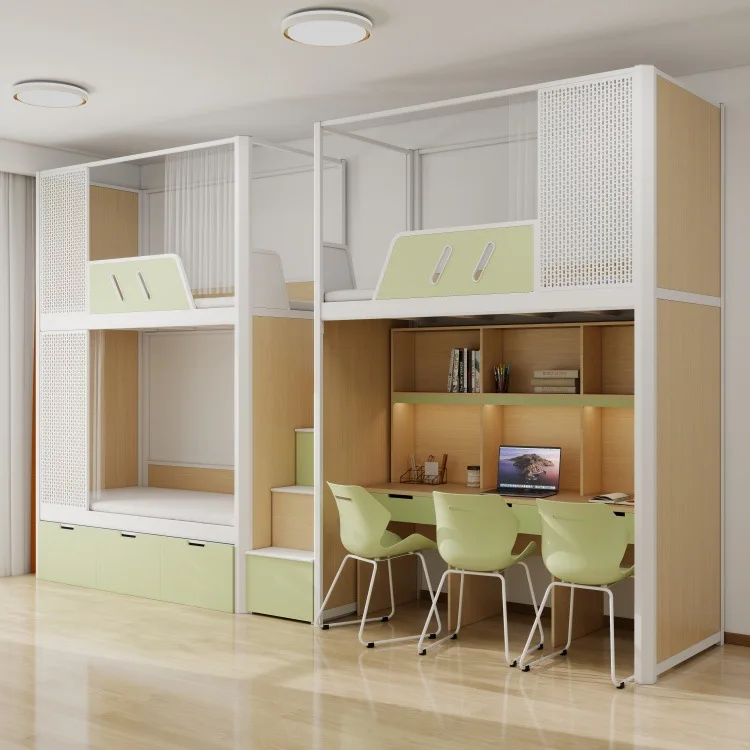
A bunk bed with desk is a compound piece of furniture that must bear multiple simultaneous loads — the weight of a sleeping occupant on the upper bunk, the weight of a person sitting or working at the desk, and the structural stress of daily use over many years. Each of these load points has its own requirements, and a well-engineered bunk bed with desk must account for all of them together. This article walks through the key weight capacity considerations you need to evaluate before making a purchase decision.
Understanding the Load Points on a Bunk Bed with Desk
The Upper Bunk Sleeping Surface
The upper bunk is the highest-risk load point on any bunk bed with desk configuration. It sits elevated off the ground, meaning any structural weakness is amplified by height and leverage. Most standard bunk bed with desk models designed for children or teenagers specify an upper bunk capacity ranging from 150 to 220 pounds, but this figure alone is not sufficient for adult use or heavier occupants.
When evaluating the upper bunk capacity, you should consider not just the static weight of the person sleeping, but also dynamic loads — the force generated when someone climbs up, rolls over, or sits up suddenly. Dynamic loads can momentarily exceed static weight by a significant margin, so a bunk bed with desk that is rated at exactly the user's body weight offers very little safety margin.
For dormitory or apartment use where adult occupants are expected, look for a bunk bed with desk that specifies an upper bunk capacity of at least 250 to 300 pounds. Iron frame or heavy-duty steel frame models are typically better suited to these demands than lightweight wood or MDF constructions.
The Lower Bunk and Desk Surface
The lower bunk on a bunk bed with desk often doubles as a seating area or study zone during the day, which means it experiences a different pattern of use than a standard bed. People may sit on the edge, lean against the frame, or place heavy items on the mattress surface. The lower bunk capacity on most bunk bed with desk models tends to be higher than the upper bunk, often rated between 200 and 400 pounds depending on the frame material and construction quality.
The integrated desk surface is another critical load point. A bunk bed with desk typically features a cantilevered or bracket-supported desk that must handle the weight of books, a laptop, monitors, and the downward pressure of a person leaning or writing. Desk surface capacities on a bunk bed with desk generally range from 50 to 150 pounds, and this figure should be clearly stated by the manufacturer.
If the intended user plans to place heavy equipment such as a desktop computer, multiple monitors, or stacked textbooks on the desk, prioritize a bunk bed with desk that explicitly rates its desk surface for at least 100 pounds of distributed load. Concentrated point loads — such as a single heavy item placed at the edge — can stress the desk bracket far more than the rated capacity suggests.
Frame Material and Its Impact on Weight Capacity
Iron and Steel Frame Construction
The frame material is the single most important determinant of weight capacity in a bunk bed with desk. Iron frame and heavy-gauge steel frame models consistently outperform wood and engineered wood alternatives in terms of load-bearing ability. A well-constructed iron frame bunk bed with desk can support upper bunk loads of 300 pounds or more while maintaining structural rigidity over years of daily use.
The wall thickness of the metal tubing matters significantly. A bunk bed with desk built from thick-walled square or round steel tubing will distribute loads more evenly and resist bending under dynamic stress. Thin-walled tubing may meet minimum capacity ratings under controlled test conditions but can deform or fatigue over time under real-world use patterns.
Welding quality is equally important. On a metal bunk bed with desk, the joints between vertical posts, horizontal rails, and desk brackets are the most vulnerable points. Look for full-penetration welds rather than tack welds, and check whether the manufacturer provides any information about weld inspection or quality control processes.
Wood and Engineered Wood Considerations
Solid wood bunk bed with desk models can offer respectable weight capacities when built from dense hardwoods such as beech, oak, or pine. However, the capacity is highly dependent on joint construction — mortise-and-tenon or dowel joints with proper adhesive bonding perform far better than simple screw-and-bracket assemblies under repeated loading.
Engineered wood products such as MDF or particleboard are commonly used in budget bunk bed with desk models to reduce cost. These materials have significantly lower structural strength than solid wood or metal, and their capacity ratings should be treated with caution. MDF in particular is prone to failure at fastener points when subjected to repeated dynamic loads, which is a serious concern for the upper bunk of any bunk bed with desk.
If a wood bunk bed with desk is preferred for aesthetic reasons, ensure that the structural members — posts, rails, and ladder supports — are solid wood, even if panel surfaces use engineered wood. This hybrid approach can deliver acceptable capacity while keeping costs manageable.
Multi-Person Configurations and Total System Load
Three-Person Bunk Bed with Desk Layouts
Some bunk bed with desk designs are engineered to accommodate three occupants simultaneously — typically with two sleeping surfaces stacked vertically and a desk integrated at one end or beneath the lower bunk. In these configurations, the total system load can easily exceed 600 pounds when all sleeping surfaces are occupied and the desk is in use.
A three-person bunk bed with desk places exceptional demands on the vertical posts and floor anchoring system. The cumulative load from multiple occupants, combined with the leverage effect of the upper sleeping surface, creates bending moments that a standard two-person bunk bed with desk is not designed to handle. Always verify that the manufacturer has rated the specific model for multi-person simultaneous use rather than simply adding individual surface capacities together.
Floor anchoring becomes non-negotiable in a three-person bunk bed with desk. Wall brackets or floor anchors that prevent tipping and lateral movement are essential safety features, not optional accessories. The combined center of gravity of a fully loaded three-person bunk bed with desk is significantly higher than a standard bed, making tip-over risk a real concern without proper anchoring.
Dormitory and Apartment Use Cases
In dormitory and shared apartment settings, a bunk bed with desk must be treated as commercial-grade furniture even if it is purchased through residential channels. Occupants change frequently, body weights vary widely, and the furniture is used intensively with less care than privately owned pieces. For these environments, a bunk bed with desk with a minimum upper bunk capacity of 300 pounds and a desk capacity of at least 100 pounds is a practical baseline.
Institutional buyers should also consider the cumulative fatigue life of the bunk bed with desk. A piece rated for 250 pounds under a single static test may degrade significantly after two or three years of heavy dormitory use. Requesting information about fatigue testing or cycle testing from the manufacturer is a reasonable step for bulk procurement decisions.
Safety Standards and Certification for Weight Capacity
Relevant Testing Standards
Weight capacity claims on a bunk bed with desk should ideally be backed by third-party testing against recognized standards. In the United States, ASTM F1427 covers safety requirements for bunk beds including structural integrity and load testing. In Europe, EN 747 sets equivalent requirements. A bunk bed with desk that has been tested and certified to these standards provides a higher level of assurance than one with only manufacturer-stated capacity figures.
These standards typically require that a bunk bed with desk withstand a specified static load applied to the sleeping surface for a defined period without permanent deformation. Some standards also include dynamic load tests that simulate the impact of a person jumping or dropping onto the mattress surface. Understanding which tests a specific bunk bed with desk has passed helps you assess whether the capacity rating reflects real-world use conditions.
Interpreting Manufacturer Capacity Ratings
Manufacturer capacity ratings for a bunk bed with desk are not always directly comparable. Some manufacturers state the maximum load the structure can bear before failure, while others state a recommended working load that includes a safety factor — typically 1.5 to 2 times the expected use load. Always ask whether the stated capacity is a maximum failure load or a recommended working load before making a comparison.
A bunk bed with desk rated at 200 pounds maximum failure load offers far less real-world safety margin than one rated at 200 pounds working load with a 2x safety factor. When capacity information is ambiguous, request clarification from the supplier or look for models where the testing methodology is explicitly documented.
It is also worth noting that capacity ratings for a bunk bed with desk are typically based on evenly distributed loads. If a mattress is used that concentrates weight at specific points, or if the desk is loaded asymmetrically, actual structural performance may differ from the rated capacity. Choosing a bunk bed with desk with a generous safety margin above your expected use load is always the prudent approach.
Practical Guidelines for Selecting the Right Capacity
Matching Capacity to User Profile
The starting point for any capacity decision is the actual weight of the intended users. For a bunk bed with desk intended for children under 12, an upper bunk capacity of 150 to 200 pounds is generally adequate. For teenagers, a minimum of 200 to 250 pounds is more appropriate. For adult users in dormitory or apartment settings, 300 pounds or more on the upper bunk is the responsible minimum for a bunk bed with desk.
Add a meaningful buffer above the user's actual weight to account for dynamic loads, mattress weight, bedding, and any items stored on the sleeping surface. A practical rule of thumb is to select a bunk bed with desk rated at least 30 to 50 percent above the expected static load. This buffer ensures the structure operates well within its design limits under normal use conditions.
Long-Term Durability and Maintenance
Weight capacity is not a fixed property of a bunk bed with desk — it can degrade over time if the structure is not properly maintained. Loose fasteners, damaged welds, cracked wood joints, and corroded metal components all reduce the effective load-bearing capacity of a bunk bed with desk below its original rating. Establishing a routine inspection schedule — checking fasteners, joints, and structural members every six months — helps ensure the bunk bed with desk continues to perform safely throughout its service life.
For metal bunk bed with desk models, surface coating integrity matters for long-term capacity. Rust and corrosion weaken steel tubing from the inside out, and a bunk bed with desk used in humid environments such as coastal dormitories or poorly ventilated rooms is particularly vulnerable. Powder-coated or galvanized finishes provide better corrosion resistance than simple paint, and any chips or scratches in the coating should be touched up promptly to prevent rust initiation.
FAQ
What is a safe weight capacity for the upper bunk of a bunk bed with desk for adult users?
For adult users, the upper bunk of a bunk bed with desk should be rated for at least 250 to 300 pounds as a working load, not a maximum failure load. This provides an adequate safety margin for dynamic loads generated during normal use. Iron or heavy-gauge steel frame models are generally better suited to adult weight requirements than wood or engineered wood alternatives.
Does the desk surface of a bunk bed with desk have a separate weight capacity from the sleeping surfaces?
Yes, the desk surface on a bunk bed with desk typically has its own separate capacity rating, which is independent of the sleeping surface ratings. Desk surface capacities commonly range from 50 to 150 pounds. If you plan to use the desk for heavy equipment such as multiple monitors or a desktop computer, verify that the desk capacity of the bunk bed with desk is rated for at least 100 pounds of distributed load.
How do I verify that a bunk bed with desk meets recognized safety standards for weight capacity?
Ask the supplier whether the bunk bed with desk has been tested against ASTM F1427 (US) or EN 747 (Europe) by an accredited third-party laboratory. Request the test report or certification documentation rather than relying solely on marketing claims. A bunk bed with desk backed by documented third-party testing provides a significantly higher level of assurance than one with only manufacturer-stated capacity figures.
Can a bunk bed with desk designed for children safely support adult occupants?
Not necessarily. A bunk bed with desk designed and rated for children typically has lower capacity thresholds and may use lighter-gauge materials than models intended for adult or institutional use. Using a children's bunk bed with desk for adult occupants without verifying the capacity ratings against adult body weights and dynamic load requirements is a safety risk. Always match the product specification to the actual user profile rather than assuming a bunk bed with desk is universally suitable across age groups.
Table of Contents
- Understanding the Load Points on a Bunk Bed with Desk
- Frame Material and Its Impact on Weight Capacity
- Multi-Person Configurations and Total System Load
- Safety Standards and Certification for Weight Capacity
- Practical Guidelines for Selecting the Right Capacity
-
FAQ
- What is a safe weight capacity for the upper bunk of a bunk bed with desk for adult users?
- Does the desk surface of a bunk bed with desk have a separate weight capacity from the sleeping surfaces?
- How do I verify that a bunk bed with desk meets recognized safety standards for weight capacity?
- Can a bunk bed with desk designed for children safely support adult occupants?